|
Some Keys for Deciphering the Ways of the Walleye at Milford Lake, Kansas
When Cabela's National Team Championship walleye tournament arrives at
Milford Lake, Kansas, on June 6-7, the bulk of the contestants' quarry will
be roaming on shallow flats, humps, and points.
In early June, the water temperature normally hovers around 73 degrees.
At that temperature, the majority of Milford's walleye forage upon a variety
of such invertebrates as bloodworms and immature mayflies.
Traditionally Milford's water clarity ranges from two to five feet. The
clearest water is found from Rush Creek to the riprap of the dam. And the
dirtiest water can be found from Madison Creek to the riprap of the
Wakefield causeway. During 2002 and 2003, a severe drought caused the lake
level to drop seven feet below normal, allowing the clarity to improve to
seven feet in spots. But even throughout a drought, algal blooms and harsh
winds erupt, clouding the water clarity, and reducing the visibility to just
a couple of feet in the lower third of the reservoir.
Since Milford is a flatland reservoir, lying in the middle of one of the
world's greatest grasslands, anglers are frequently tormented by ranks of
heavy white caps that course the length of the lake, running from Curtis
Creek to Madison Creek. Yet on those days when an extremely stiff wind
angles out of the southwest or south, anglers can find some refuge and some
walleye in several of the bigger feeder creeks.
Natural walleye recruitment at Milford is problematic and often
insignificant. Therefore, a regular and extensive stocking program by the
Kansas Department of Wildlife and Parks augments the population. For
instance, the KDWP stocked 125,457 fingerling walleye and 5,082,200 fry in
2002.
A jig and a nightcrawler is the traditional tool of the dyed-in the-wool
Kansas walleye angler. Anglers use it to drift with the aid of the wind
across massive expanses of flats or points, allowing the jig head to drag
and bounce on the bottom. And on those rare days when the wind fails to
blow in Kansas, anglers use their electric trolling motors to slowly
maneuver the boat and drag the jig across significant features on the flats
and points. Anglers also use a vertical motif to carefully probe such subtle
spots as rock piles, brush piles, ledges and stumps with the jig and
crawler.
And it should be noted that a plethora of PVC skeletons, rock piles and
tree piles have been recently constructed on various contours of the lake.
Although spinner rigs, as well as other crawler and leech rigs, are
seldom employed by Kansas anglers, tournament participants from other state
might teach Kansas anglers a thing or two about the effectiveness of these
walleye tools during the heat of this June's tournament.
The art of pitching a lightweight jighead festooned with a piece of a
nightcrawler at visible logs, stumps and boulders isn't in the repertoire of
the traditional Kansas walleye angler. But there are some spots at Milford
where this finesse tactic might yield a few dividends for a tournament
angler.
Even though the Milford's walleye will be feeding primarily of
invertebrates or aquatic insect in their larval and pupal stages in early
June, there are times when anglers can entice impressive array of fish by
casting and slowly retrieving crankbaits on rocky points, shallow humps, and
shallow foundations. Moreover, clay points that are graced with a shelf or
ledge can also attract some walleye that can be allured with a crankbait.
Anglers suspect that these walleye are feeding on gizzard shad, shiners and
large crustaceans.
Traditionally, the three-inch, 1/8-ounce Lindy Shadling was the mainstay
of Kansas walleye anglers who plied shallow-water environs during low-light
periods or when the wind blew at a moderate pace. Nowadays anglers also
use such lures as a No. 5 Rapala Shad Rap. And on windy outing a large
lipless crankbait can periodically yield several nice-sized specimen.
On extremely windy days, anglers frequently troll crankbaits across
points, humps and flats, focusing on water as shallow as three feet and no
deeper than 10 feet. And when the wind doesn't howl, tournament anglers
might reap some sizable catches by trolling deep-diving crankbaits along
subtle ledges, as well as significant drop offs, in 10 to 15 feet of water.
Across the years, newcomers to Kansas walleye fishing have been
confounded by their sonars. In fact, years ago several walleye experts from
Lindy Little Joe of Brainerd, Minnesota, discovered that Milford had too
many fish -- primarily rough fish - to allow anglers to use their sonars to
find walleye. Instead, it is recommended that walleye fishers use their
sonars as a tool to locate the best coverts to probe with a jig, rig, or
crankbait.
From the perspective of many veteran Milford walleye fishermen, the
murkier and shallower environs of the upper end of lake are where anglers
traditionally fish rather precisely and slowly. The lake's middle section
is where a moderate fishing pace normally shines. And around the
clear-water areas near the dam, anglers often work quickly and aggressively.
But topnotch tournament fishermen have a habit of finding exceptions to the
many rules of thumb, and it will be interesting to see if some of the teams
of accomplished walleye anglers, competing in the Cabela's National Team
Championship, will finish high on the leaderboard by employing a few
unorthodox tactics on Milford's walleye.
|
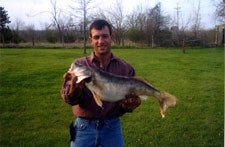 Milford is nestled in the picturesque Flint Hills and fed by the
Republican River and seven feeder creeks. The topography of this
16,020-acre reservoir rests upon a bed of limestone, chert, and clay. Some
of its shoreline consists of limestone bluffs. There are also many miles of
clay banks, humps, and points, and some of them are laced with rock
outcroppings, submerged roadbeds, and foundations and rubble of former
farmsteads. Besides miles of limestone bluffs and clay shorelines, Milford
is graced with scores of rocky and gravelly points and banks.
Milford is nestled in the picturesque Flint Hills and fed by the
Republican River and seven feeder creeks. The topography of this
16,020-acre reservoir rests upon a bed of limestone, chert, and clay. Some
of its shoreline consists of limestone bluffs. There are also many miles of
clay banks, humps, and points, and some of them are laced with rock
outcroppings, submerged roadbeds, and foundations and rubble of former
farmsteads. Besides miles of limestone bluffs and clay shorelines, Milford
is graced with scores of rocky and gravelly points and banks.

Classifieds | Tourney Finder | Live Leaderboard | Products | WC Gear
© 1995 - 2010 Golden Coyote Inc.
 Your Privacy Choices